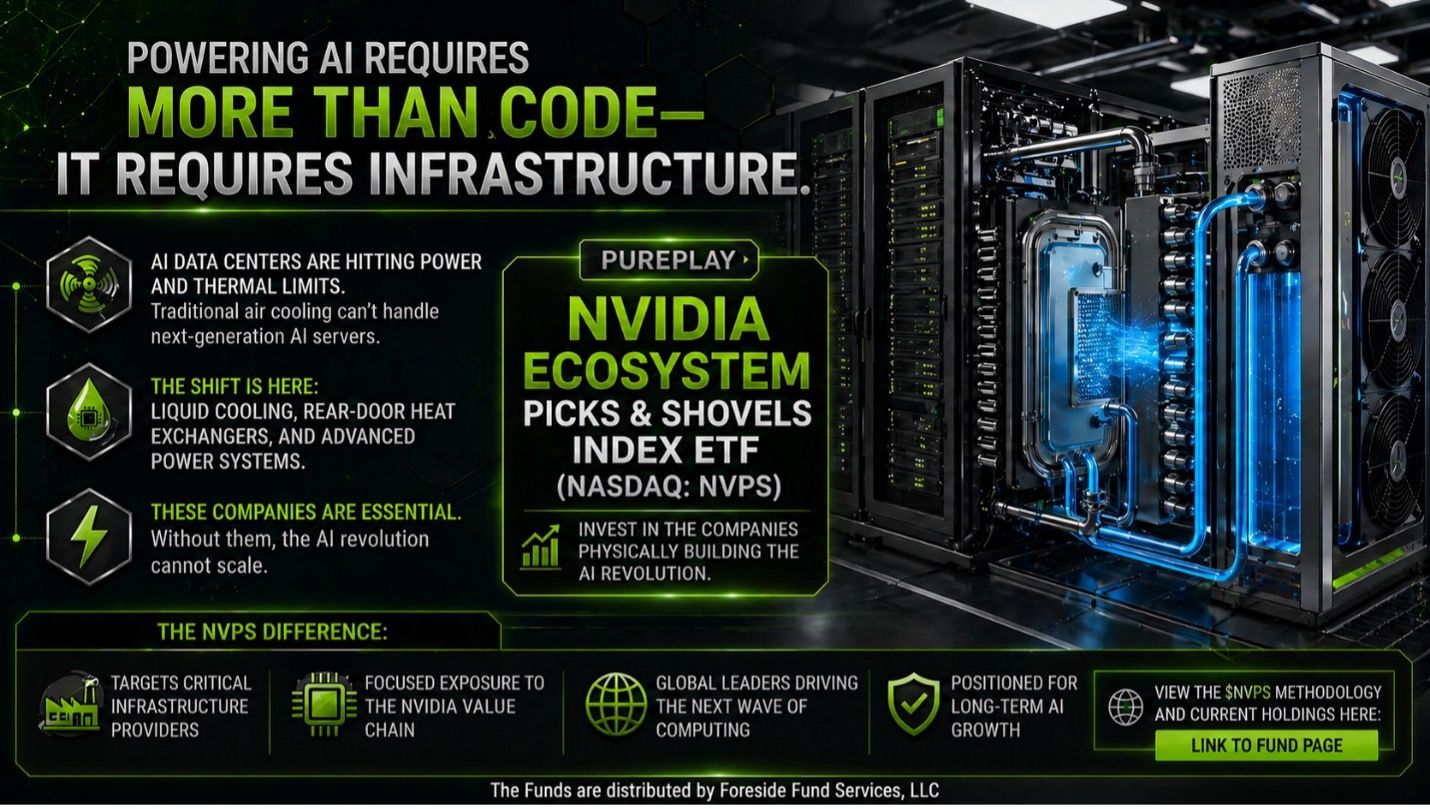
When investors think of the artificial intelligence revolution, they typically picture software, algorithms, and the advanced graphics processing units (GPUs) processing data in the cloud.
However, the "cloud" is a physical place, and the most significant hurdle to scaling AI isn't just writing better code—it is the brutal physical reality of thermodynamics and electricity.
AI is driving one of the most massive physical infrastructure build-outs in modern history. For financial advisors navigating this space, we believe that understanding this hardware bottleneck is critical to finding true thematic value.
That is exactly why we built the PurePlay Nvidia Ecosystem Picks & Shovels Index ETF (NASDAQ: NVPS). Designed to move beyond single-stock exposure, NVPS seeks to track the critical infrastructure, cooling, and power companies physically enabling the AI ecosystem.
[Explore the NVPS Prospectus and Current Holdings Here]
The Power Density Problem
To understand why physical infrastructure is the true bottleneck of the AI boom, you have to look at the math inside a modern data center. Traditional data centers, built to handle standard enterprise software and web hosting, are designed to support server racks that draw roughly 5 to 10 kilowatts (kW) of power.
Next-generation AI server racks, packed with densely clustered GPUs training complex large language models, can draw upwards of 40 to 100+ kW per rack. The legacy electrical grid and existing data center infrastructure are simply not equipped to handle this level of electrical density. Upgrading these facilities requires a massive, sustained capital expenditure cycle focused on specialized power distribution units, backup generators, advanced switchgear, and uninterruptible power supplies.
The Liquid Cooling Revolution
With extreme power comes extreme heat. Traditional air-conditioning systems (CRAC units) cannot push enough chilled air to keep a 100kW AI server rack from literally melting down. This physical limitation is forcing the data center industry to completely retrofit its thermal management architecture.
The industry is rapidly shifting toward direct-to-chip liquid cooling—where specialized coolants are piped directly over the processing units—and advanced rear-door heat exchangers. The companies engineering, manufacturing, and installing these highly complex thermal management systems are experiencing a generational demand shock. Their equipment is no longer an optional upgrade; it is a mandatory requirement for any data center attempting to run modern AI workloads.
Targeting the True Picks and Shovels
The companies solving these power and cooling bottlenecks operate deep within the supply chain, often out of the mainstream financial media's spotlight. Yet, without them, the deployment of advanced computing systems simply stops.
Instead of broadly buying the technology sector and hoping for tangential AI exposure, investors can look directly at the value chain. NVPS is designed to provide targeted exposure to the specific thermal management, power distribution, and facility-level engineering companies that make the operation of high-performance compute systems possible.
For investors seeking to capture the physical footprint of the AI boom, the picks and shovels are just as critical as the gold.



Investors should consider the investment objectives, risks, charges and expenses carefully before investing. For a prospectus or summary prospectus with this and other information about the Fund, please visit the website at www.pureplayetfs.com. Read the prospectus or summary prospectus carefully before investing.
The Fund is distributed by Foreside Fund Services, LLC. Exchange Traded Concepts, LLC serves as the investment advisor of the Fund. Foreside Fund Services, LLC is not affiliated with Exchange Traded Concepts, LLC or any of its affiliates.
Risk Disclosures:
Investing involves risk, including possible loss of principal. There is no guarantee the Fund will achieve their stated objectives.
New/Smaller Fund Risk. A new or smaller fund is subject to the risk that its performance may not represent how the fund is expected to or may perform in the long term. In addition, new funds have limited operating histories for investors to evaluate and new and smaller funds may not attract sufficient assets to achieve investment and trading efficiencies.
Non-Diversification Risk. The Fund is non-diversified under the 1940 Act, meaning that, as compared to a diversified fund, it can invest a greater percentage of its assets in securities issued by or representing a small number of issuers. As a result, the performance of these issuers can have a substantial impact on the Fund’s performance.
NVIDIA Dependence Risk. Because the Index is designed to provide exposure to companies that have a material commercial relationship with NVIDIA, the Index, and therefore the Fund, is highly sensitive to NVIDIA-specific developments. Actual or perceived adverse events at NVIDIA, including financial distress, demand declines, supply or regulatory disruptions, litigation, reputational harm, strategic shifts, or insolvency, could impair the results and valuations of Index constituents that rely on NVIDIA as a key customer, supplier, or technology partner, leading to material declines and heightened volatility in the Fund.