NVIDIA's latest earnings report offered more than another update on AI accelerator demand. Beneath the headline financial results was a significant amount of commentary about the physical infrastructure required to support the next phase of AI growth.
For investors focused on the semiconductor supply chain, several developments stood out.
NVIDIA reported $96.2 billion of quarterly revenue, up 106% year over year, while Data Center revenue reached $89.0 billion, up 117%. Management also provided a preliminary outlook for approximately 70% revenue growth in fiscal 2028, while explicitly noting that this remains a supply-constrained outlook.
That combination of strong demand and constrained supply puts the companies supporting NVIDIA's hardware ecosystem directly in focus.
The PurePlay NVIDIA Ecosystem Picks & Shovels Index ETF (NASDAQ: NVPS) is designed to provide targeted exposure to this broader hardware ecosystem. NVPS spans the physical value chain supporting AI—from memory and advanced semiconductor manufacturing equipment to connectivity and infrastructure.
Explore the NVPS Prospectus and Current Holdings Here
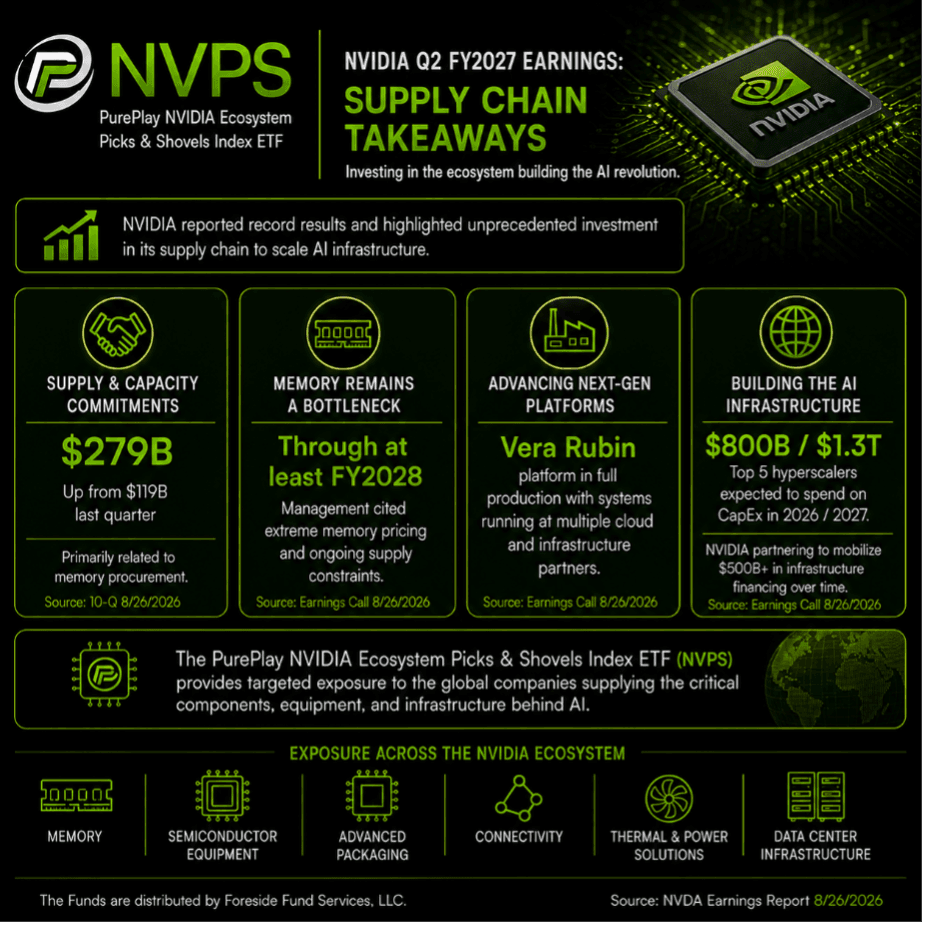
NVIDIA Is Increasing Its Supply Commitments
Perhaps the clearest supply-chain signal in the report was the sharp increase in NVIDIA's future supply and capacity commitments.
As of July 26, NVIDIA had $279 billion of supply and capacity commitments, compared with $119 billion three months earlier. The increase was primarily related to memory procurement, reflecting the company's efforts to secure critical components and manufacturing capacity ahead of expected demand.
The commitments are heavily front-loaded. Approximately $92 billion is scheduled for the remainder of fiscal 2027, followed by $87 billion in fiscal 2028 and $88 billion in fiscal 2029. These figures represent commitments rather than expenses already incurred, and some arrangements can be adjusted before firm orders are placed.
The magnitude of those commitments provides a useful window into how much physical capacity NVIDIA expects the AI infrastructure buildout to require.
Memory Has Become a Central Constraint
Memory was one of the most important supplier-related topics discussed during the earnings call.
CFO Colette Kress said NVIDIA is experiencing "extreme pricing conditions in memory" and that supply is expected to remain a bottleneck through at least fiscal 2028. She also noted that NVIDIA has longstanding relationships with all three major memory suppliers and is working closely with them to increase the capacity required for its product roadmap.
CEO Jensen Huang reinforced the importance of this upstream relationship, explaining that NVIDIA has deliberately worked with memory suppliers well upstream in the supply chain to prepare for future computing demand.
For the broader ecosystem, this highlights the strategic importance of companies supplying High-Bandwidth Memory and other critical components required for increasingly complex AI systems.
The Supply Chain Extends Beyond Memory
NVIDIA's commentary also emphasized that scaling AI infrastructure requires coordination well beyond GPUs and memory.
Huang discussed the need to secure land, power, cooling, labor, manufacturing capacity and other infrastructure well ahead of deployment. NVIDIA is increasingly involved in securing these resources further upstream and downstream in the infrastructure buildout.
The company also highlighted its next-generation Vera Rubin platform entering full production, with systems running at multiple cloud and infrastructure partners. NVIDIA's release additionally announced a multiyear technology partnership with SK hynix to advance next-generation memory for the global AI factory buildout.
The broader message is straightforward: increasing AI compute requires an increasingly complex physical supply chain.
A Broader AI Infrastructure Buildout
The scale of the demand extends beyond traditional hyperscalers. NVIDIA said its customer base is broadening across AI labs, enterprises, sovereign customers and neocloud providers. The company also said the top five hyperscalers are expected to spend nearly $800 billion on capital expenditures in 2026 and $1.3 trillion in 2027.
NVIDIA is also partnering with major financial institutions to establish independent compute financing platforms intended to mobilize more than $500 billion of third-party capital for AI infrastructure over time, subject to definitive agreements.
These figures illustrate the scale of investment required across the physical AI ecosystem—from semiconductor manufacturing and memory to networking, power, cooling and data-center infrastructure.
Following the Picks and Shovels Behind NVIDIA
The latest earnings report reinforces an important distinction in the AI investment landscape: NVIDIA may design the processors at the center of the AI ecosystem, but producing and deploying those processors requires a global network of specialized suppliers.
Memory manufacturers, semiconductor equipment companies, packaging providers, networking companies, power and cooling infrastructure providers, and data-center operators all participate in the physical buildout.
As NVIDIA's latest results demonstrate, tracking the AI opportunity increasingly means looking beyond the GPU itself and toward the companies responsible for supplying the components, tools and infrastructure required to scale it.



Investors should consider the investment objectives, risks, charges and expenses carefully before investing. For a prospectus or summary prospectus with this and other information about the Fund, please visit the website at www.pureplayetfs.com. Read the prospectus or summary prospectus carefully before investing.
The Fund is distributed by Foreside Fund Services, LLC. Exchange Traded Concepts, LLC serves as the investment advisor of the Fund. Foreside Fund Services, LLC is not affiliated with Exchange Traded Concepts, LLC or any of its affiliates.
Risk Disclosures:
Investing involves risk, including possible loss of principal. There is no guarantee the Fund will achieve their stated objectives.
New/Smaller Fund Risk. A new or smaller fund is subject to the risk that its performance may not represent how the fund is expected to or may perform in the long term. In addition, new funds have limited operating histories for investors to evaluate and new and smaller funds may not attract sufficient assets to achieve investment and trading efficiencies.
Non-Diversification Risk. The Fund is non-diversified under the 1940 Act, meaning that, as compared to a diversified fund, it can invest a greater percentage of its assets in securities issued by or representing a small number of issuers. As a result, the performance of these issuers can have a substantial impact on the Fund’s performance.
NVIDIA Dependence Risk. Because the Index is designed to provide exposure to companies that have a material commercial relationship with NVIDIA, the Index, and therefore the Fund, is highly sensitive to NVIDIA-specific developments. Actual or perceived adverse events at NVIDIA, including financial distress, demand declines, supply or regulatory disruptions, litigation, reputational harm, strategic shifts, or insolvency, could impair the results and valuations of Index constituents that rely on NVIDIA as a key customer, supplier, or technology partner, leading to material declines and heightened volatility in the Fund.